

When investing in real estate, choosing between cash flow and appreciation is a pivotal decision. These two strategies offer unique benefits, and selecting the right one depends on your financial goals, risk tolerance, and investment timeline. Let’s explore both, weigh the pros and cons, and help you decide which aligns with your objectives.
Cash flow refers to the net income generated from a rental property after deducting expenses like mortgage payments, taxes, insurance, and maintenance.
Example: Imagine you purchase a duplex for $200,000 with a 20% down payment. Your monthly expenses (mortgage, taxes, insurance) total $1,200. If you collect $2,000 in rent, your monthly cash flow is $800, or $9,600 annually.
Appreciation is the increase in a property’s value over time. Investors relying on this strategy buy properties in growth areas, betting on price increases.
Example: Suppose you purchase a single-family home for $300,000 in a rapidly growing neighborhood. After five years, the property value rises to $400,000. Your gain is $100,000, not including expenses or potential rental income.
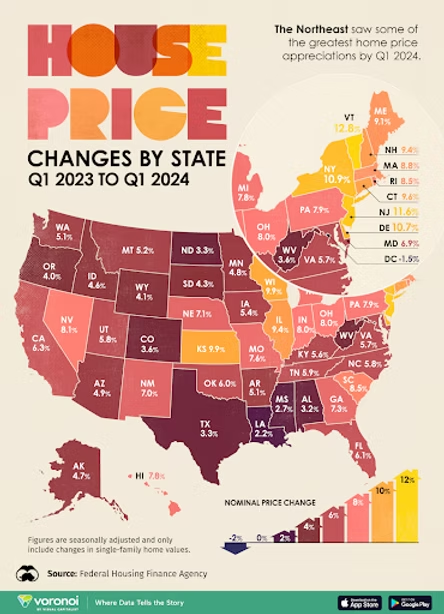
Focus on cash flow. Ideal for retirees or passive income seekers, target affordable markets like Cleveland, OH, or Memphis, TN, where rents are high relative to property prices.
Example:
Choose appreciation, suited for younger investors or high-income earners who can wait for returns. Northeast markets are appreciating fastest in 2024 but have higher entry costs.
What to Look For:
Combine moderate cash flow with appreciation in growing suburban areas like Raleigh, NC, or Austin, TX.
Example:
By aligning with your financial goals and doing due diligence, you can optimize your investments.
Understanding the trade-offs between cash flow and appreciation is critical. For a diversified portfolio, many seasoned investors include both strategies—leveraging cash flow properties for stability while capitalizing on appreciation for growth.
Whichever path you choose, thorough market research and tools like PropIQ can help you identify the best opportunities, evaluate property performance, and make informed investment decisions.